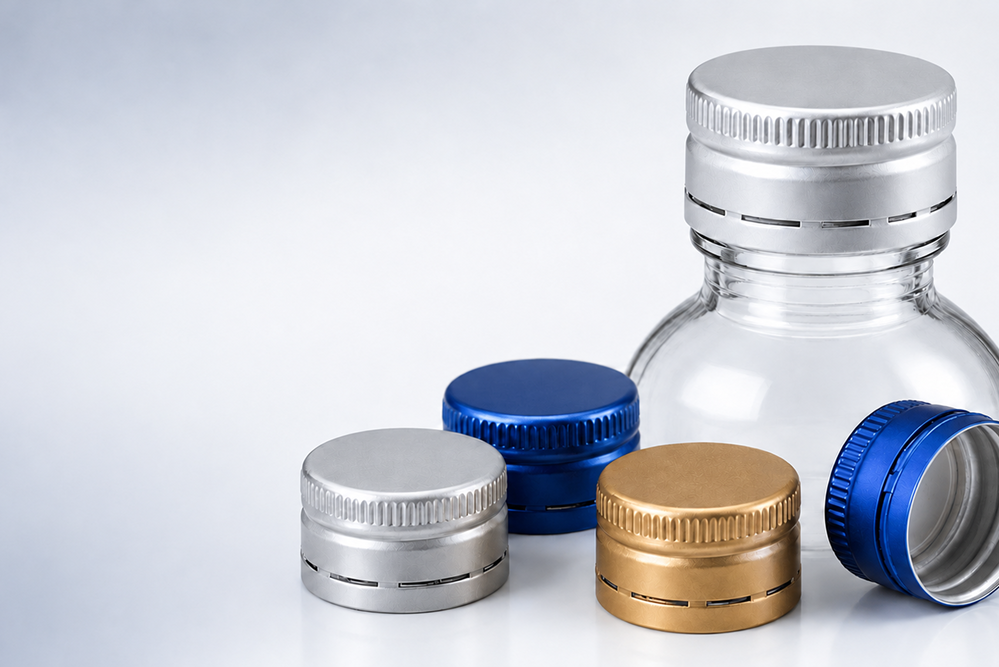
A bottle closure does more than cover the opening of a container. It must support sealing performance, protect the packed product, and show visible signs of first opening. Roll On Pilfer Proof caps are now the standard closure for bottles across pharmaceuticals, beverages, liquor, food, and other packaged goods. These aluminium closures ship as smooth, unthreaded shells.
These closures are applied using a capping machine that forms threads directly onto the bottle neck. Spinning rollers then shape the soft metal directly around the threads. This mechanism forms a secure seal that helps reduce leakage when properly applied.
If you plan to use aluminium screw caps to ensure product safety and sealing performance, have an idea of what exactly ROPP caps are.
ROPP caps are metal caps that are rolled over the bottleneck during the process of capping. However, other types of caps always come with pre-threaded caps, while these lack threads until they are put on the bottle using a special capping machine.
"Pilfer-proof" is the name given to the tamper-evident strip found at the base of the cap. After opening the cap, this strip breaks off, showing the consumer that the item has been previously opened.
Pilfer-proof caps are mostly used in glass and PET bottles.
Safety of the Product : A proper seal helps reduce leakage and damage to the product during storage and transportation.
Tamper Evident: One of the features of the roll-on pilfer-proof caps is that they are tamper-evident. The lower band breaks when the cap is opened for the first time, which makes it tamper-evident.
The cap is formed and sealed in a single pass through a capping machine:
1. Positioning - A smooth, threadless cap is placed over the bottle mouth. The bottle's neck finish has to match the cap for the seal to hold.
2. Sealing - The capping head presses the cap down, compressing the liner against the bottle opening to prevent leakage during storage and transport.
3. Threading - Spinning rollers press against the soft aluminium shell, forming threads directly on the cap so it can later be twisted open.
4. Tamper-band formation -The lower edge of the cap is curled under the bottle's neck ring, creating the pilfer-proof band.
5. First opening - Twisting the cap breaks the perforated metal bridge connecting the band to the cap body, leaving a detached lower ring as visible proof the bottle has already been open
The reliability of the ROPP caps is well known across various industries because of the secure sealing feature.
1) Pharmaceutical Industry – Syrups, tonics, liquid medicine.
2) Beverage Industry – Juices and health drinks.
3) Liquor & Wine Industry – bottles that need a security seal.
4) Food Industry – Edible oil, sauces, syrups.
How to Choose the Right ROPP Cap for Your Product
Choosing the perfect ROPP caps involves much more than choosing the correct sizes since there are some additional things you have to do to find the perfect ROPP caps, which include the following:
Working with experienced ROPP cap manufacturers can help ensure consistent sealing performance and product quality.
Alutop has manufactured aluminium closures and printed metal sheets since 1990, supplying the pharmaceutical, food, and beverage industries. Its Bangalore facility runs 25+ production lines across 150,000 sq. ft., producing close to 3 billion closures a year under ISO 9001:2015 certification. Alongside ROPP caps, Alutop also manufactures aluminium screw caps and printed metal sheets for pharma, beverage, and food packaging, giving buyers a single supplier to evaluate for both closure types.
ROPP caps solve a specific packaging problem: they seal the bottle, prove whether it's been opened, and carry a brand's printing without needing a pre-threaded neck finish. For buyers comparing suppliers, the details that decide the outcome are neck fit, liner selection, coating, and a production-line trial before committing to volume.